
Introduction
Your signage may be the first thing a customer sees before they speak to your team, enter your premises, or visit your website. When it works well, it attracts attention, gives clear direction, and builds trust. When it fails, it can quietly push customers away. Many businesses lose enquiries because of simple signage mistakes such as poor visibility, weak colours, unclear wording, or damaged signs. These problems often go unnoticed because the sign is already installed. This guide explains the top mistakes that lead to bad business signage, how they affect customer behaviour, and what you can do to fix them.
Why Signage Still Matters for Businesses?
A sign is not just a name board. It is part of your customer journey. It helps people find you, understand what you offer, and decide whether your business looks professional enough to trust.
For retail shops, signage can bring people in from the street. For offices, it helps visitors, staff, and clients move around with confidence. For commercial spaces, it supports safety, navigation, brand image, and daily operations.
A good sign should be easy to see, easy to read, and easy to understand. It should match your brand and suit the place where it is installed. If any of these parts fail, the sign may still exist, but it will not do its job properly.
That is why many businesses now review their existing signs instead of waiting until they fully replace them. A professional review can show where signs are too small, too faded, badly placed, or no longer suitable for the business. This is where a practical audit can help.
For more guidance, you can read our blog on choosing a partner before starting any new signage project.
Top 10 Signage Mistakes That Cost Businesses Customers
1. Signs That Are Too Small to Notice
One of the most common signage mistakes is using signs that are too small for the location. A sign may look fine on a screen or in a design file, but it can fail when placed on a busy road, high street, industrial estate, or large building front.
Small signs are easy to miss. Customers may walk past your shop without realising what you offer. Drivers may not have enough time to read your name. Visitors may arrive at the right building but struggle to find the correct entrance.
The business impact is simple. Poor visibility reduces footfall, delays visitors, and makes your business look less present in the area. It also means you may depend more on paid ads or online searches to bring people in.
The fix is to match sign size to viewing distance. A sign for passing traffic needs larger text than one used inside a reception area. The height, width, letter size, and viewing angle all matter. A signage audit can check whether your current signs are easy to read from the right distance.
2. Poor Colour Contrast
Colour can make a sign stand out, but poor colour contrast can make it hard to read. Light text on a light background, dark text on a dark background, or busy colour combinations can create serious signage design errors.
This problem becomes worse in poor weather, low light, or when people view the sign from a distance. A customer should not have to stop and focus hard just to read your business name or service message.
Poor contrast can make your business look less professional. It can also create access issues for people with weaker eyesight. If customers cannot read your sign quickly, they may move on to another business that looks clearer and easier to approach.
The fix is to use strong, clean contrast between text and background. Black on white, white on dark colours, and simple brand-led combinations often work better than complex designs. The design should look good, but it must also work in real life.
You can compare weak and improved layouts in our Before & After blog.
3. Unclear Wording
A sign should tell people what they need to know quickly. Some businesses use wording that is too vague, too clever, or too hard to understand. This creates confusion, especially for new customers.
For example, a shop sign may show a brand name but not explain what the business does. An office sign may use internal department names that mean little to visitors. A commercial unit may have several signs that do not give a clear next step.
The impact is often missed opportunities. Customers may not understand your offer. Visitors may enter the wrong door. People may lose confidence before they even speak to your team.
The fix is to keep wording simple. Your main sign should make your name clear. Supporting signs should explain key services, entrances, opening hours, directions, or safety instructions where needed. Avoid long messages on signs that people need to read quickly.
Good signage does not try to say everything. It says the right thing at the right point.
How Poor Signage Affects Trust, Footfall, Sales, and Brand Image?
Poor signage affects more than appearance. It can change how customers feel about your business before they enter. If a sign looks old, unclear, damaged, or hard to follow, people may assume the business is careless in other areas too.
This can affect trust. A clean, clear sign suggests that the business pays attention to detail. A faded or broken sign gives the opposite message. Even if your service is excellent, your signage may create doubt before you get the chance to prove it.
It also affects footfall. If people cannot see you, they may not visit. If they cannot understand what you offer, they may not enquire. For businesses in busy areas, this can mean losing customers every day without knowing why.
Sales can also suffer. Clear signs support buying decisions, direct people to the right areas, and highlight important services. Weak signs create friction. Customers may feel unsure, lost, or less confident.
Brand image is another key issue. Your signage should match the quality of your business. If your online brand looks modern but your physical signage looks tired, the customer experience feels uneven.
This is why a signage audit is not just a design task. It is a business review that can help improve how people see, understand, and trust your company.
4. Wrong Sign Placement
Even a well-designed sign can fail if it is placed in the wrong location. Some signs sit too high, too low, too far from the entrance, or behind objects such as trees, parked vehicles, posts, or window displays.
Wrong placement creates confusion. Customers may arrive nearby but not know where to go. Drivers may notice the sign too late. Pedestrians may not see it from the natural walking direction.
This is a serious issue for businesses in shared buildings, retail parks, business centres, and industrial estates. If the entrance is not clear, people can feel frustrated before they even reach reception.
The fix is to review signage from the customer’s point of view. Stand where customers first arrive, walk the route they take, and check what they see at each stage. A sign should appear before the customer needs it, not after they have already guessed.
Directional signs, entrance signs, window graphics, and external boards should all work together. Placement should support the journey from first sight to final destination.
5. Damaged or Outdated Signage
Damaged signs send the wrong message. Cracked panels, faded colours, missing letters, peeling vinyl, broken lights, and stained surfaces all reduce confidence.
Customers may not think about signage in detail, but they notice when something looks neglected. If your sign looks old or broken, people may assume your business is not active, not professional, or not careful.
Outdated signs can also create practical problems. They may show old opening hours, old services, old branding, or former contact details. This can lead to missed enquiries and customer frustration.
The fix is regular maintenance. Your signs should be checked for damage, fading, dirt, lighting issues, and message accuracy. Businesses should also review signs after rebrands, service changes, relocations, and seasonal updates.
A damaged sign does not always need full replacement. In some cases, repair, cleaning, relighting, or panel updates may be enough. A professional audit can help decide the most cost-effective option.
For businesses planning upgrades, our Cost guide explains what can affect signage pricing.
6. Too Much Information on One Sign
A sign is not a brochure. One of the biggest signage design errors is trying to include too much information in one space. This can include long service lists, several phone numbers, social media handles, slogans, offers, directions, and opening hours all placed together.
When a sign carries too much text, people read less, not more. The message becomes crowded, and the main point gets lost.
This can reduce enquiries because customers do not know what to focus on. It can also make the sign look messy and unprofessional.
The fix is to give each sign one main job. An external fascia sign should identify the business. A window graphic can highlight key services. A reception sign can support brand image. A wayfinding sign can guide movement.
If more information is needed, use a clear sign system rather than one overloaded sign. Keep text short, use spacing well, and make sure the most important message stands out first.
Why Many Signage Problems Go Unnoticed?
Many business owners stop reviewing their signage once it has been installed. The sign becomes part of the building, and teams see it every day. Over time, they may stop noticing fading, weak lighting, clutter, or poor placement.
Customers see it differently. They view the sign for the first time. They do not know where the entrance is, what the business offers, or whether the company is trustworthy. This fresh view matters.
A business may blame low footfall on location, pricing, or competition, but signage could be part of the issue. If people are walking past without noticing you, or arriving but feeling unsure, the sign is not supporting the business properly.
A signage audit helps because it looks at visibility, message clarity, customer flow, materials, lighting, condition, and brand fit. It gives clear actions rather than guesswork.
This is especially useful for businesses that already have signs but are not sure whether they are helping or holding the business back.
7. Poor Lighting
Lighting is often ignored until it becomes a problem. A sign may look clear in daylight but disappear in the evening, during winter afternoons, or in poor weather.
For businesses open after dark, poor lighting can cost real customers. Restaurants, shops, gyms, clinics, offices, and service businesses all need signs that remain visible when natural light drops.
A poorly lit sign can make a business look closed, even when it is open. It can also create safety concerns around entrances, car parks, and walkways.
The fix is to review how signage performs at different times of day. External signs may need built-in lighting, trough lights, halo illumination, or better surrounding light. Internal signs may need correct placement under existing lighting.
Lighting should support readability without making the sign look harsh or difficult to view. It should also suit the building, brand, and local setting.
8. Weak Branding
Some signs show a business name but fail to express the brand clearly. This can happen when colours, fonts, layout, materials, and tone do not match the rest of the business.
Weak branding makes your business harder to remember. It can also create a poor link between your website, social media, premises, vehicles, uniforms, and printed material.
For example, a company may have a clean and modern website but an old sign using different colours and a dated style. This creates a gap in the customer’s mind. It can make the business feel less organised.
The fix is to keep signage aligned with your brand identity. Your signs should use the right logo, colours, text style, and message. They should also match the level of quality you want customers to expect.
Brand consistency does not mean every sign must look the same. It means every sign should feel like it belongs to the same business.
9. No Wayfinding Signs
Wayfinding signs help people move through a space. They are useful in offices, clinics, retail units, commercial buildings, schools, warehouses, car parks, and shared sites.
Without wayfinding, customers and visitors may feel lost. They may enter the wrong area, interrupt staff for directions, or leave with a poor impression.
This type of bad business signage often appears when external signs exist, but internal direction signs are missing. The customer can find the building but not the reception, department, meeting room, till point, toilet, lift, or exit.
The business impact includes delays, frustration, weaker customer experience, and extra pressure on staff. In some settings, poor wayfinding may also affect safety.
The fix is to map the customer journey. Identify where people pause, hesitate, or ask questions. Add simple signs at these decision points. Use clear arrows, plain wording, and consistent design.
Good wayfinding should feel natural. People should know where to go without needing to ask.
10. Choosing Cheap Materials
Low-cost materials may save money at the start, but they can cost more over time. Cheap signs often fade, warp, crack, peel, or lose their finish sooner than expected.
This is a common issue for outdoor signs exposed to rain, sun, wind, dirt, and temperature changes. It can also affect indoor signs in busy areas where surfaces are touched, cleaned, or knocked often.
Poor materials damage brand image. They can make a business look temporary, careless, or low quality. They may also require frequent repairs or early replacement.
The fix is to choose materials based on location, use, weather exposure, brand needs, and expected lifespan. Not every sign needs the most expensive material, but every sign should be suitable for its purpose.
A signage provider can help you choose between acrylic, aluminium composite, vinyl, illuminated signs, window graphics, built-up letters, and other options. The right choice should balance cost, durability, and appearance.
How to Fix Signage Mistakes Before They Cost More?
The best way to fix signage problems is to review your signs as a full system, not as separate items. Start by looking at your external signs, entrance signs, window graphics, internal direction signs, reception signs, safety signs, and promotional signs.
Ask simple questions. Can people see the business from the street? Can they read the sign quickly? Is the message clear? Does the sign look clean and current? Can customers find the entrance? Do the signs match the brand?
Then review the signs at different times of day. A sign that works at noon may fail in the evening. A sign that looks clear up close may not work from across the road.
It is also useful to ask staff what customers often struggle with. If visitors regularly ask where to park, where to enter, or where to go inside, your signage may need improvement.
A professional signage audit gives you a clear view of what is working, what is failing, and what should be improved first. It can help you avoid unnecessary spending by focusing on the changes that matter most.
When Should a Business Get a Signage Audit?
A signage audit is useful when your business already has signs but you are unsure whether they are doing their job. It is also useful after a rebrand, refurbishment, relocation, expansion, or change in services.
You should also consider an audit if customers say they struggled to find you, if footfall has dropped, if signs look faded or damaged, or if your premises no longer match your online brand.
An audit can also support planning before you invest in new signs. Instead of replacing signs without a clear reason, you can make informed decisions based on visibility, condition, customer flow, and business goals.
For lead generation, this matters because every sign should support a clear action. It may be to enter the premises, visit reception, ask about a service, scan a code, call the business, or book a consultation.
If your signage does not guide people towards that action, it needs improvement.
Conclusion: Do Not Let Poor Signage Lose Customers Quietly
Poor signage does not always create obvious problems. It can quietly reduce trust, lower footfall, confuse visitors, and weaken sales over time. A sign may be installed, but that does not mean it is working.
The most common signage mistakes are often simple: signs that are too small, colours that are hard to read, unclear wording, poor placement, old materials, weak lighting, and missing directions. Each issue can affect how customers see your business.
The good news is that many problems can be fixed with practical changes. You may not need to replace every sign. You may need better placement, clearer wording, stronger lighting, improved materials, or a more consistent sign system.
If your current signs are not bringing in the right attention, now is the time to review them. Get a signage audit and find out where your signage is helping, where it is failing, and what changes can improve customer confidence.
For support with your next signage review, contact your signage provider and request a clear audit of your current signs, customer journey, and improvement options.
FAQs
What are the most common signage mistakes businesses make?
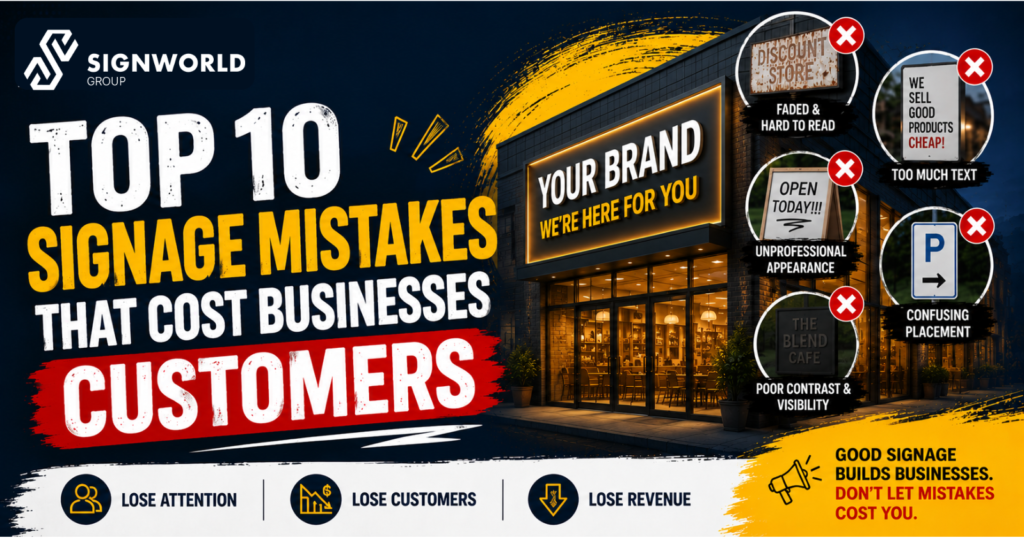
The most common mistakes include signs that are too small, poor colour contrast, unclear wording, wrong placement, damaged signs, too much information, poor lighting, weak branding, missing wayfinding, and cheap materials.
How does bad business signage affect customers?
Bad business signage can make customers miss your premises, feel confused, lose trust, or choose another business. It can also make your company look less professional, even when your service is strong.
When should I replace my business signage?
You should consider replacing signage when it is faded, damaged, outdated, hard to read, no longer matches your brand, or fails to guide customers properly. In some cases, repair or updates may be enough.
What is included in a signage audit?
A signage audit usually reviews visibility, design, wording, placement, lighting, materials, condition, brand consistency, and customer flow. It helps identify what needs fixing first.
Can better signage help increase footfall?
Yes, better signage can improve visibility, help customers understand your offer, and make your premises easier to find. This can support more walk-ins, enquiries, and stronger customer confidence.