
A sign is often the first part of a business that people notice, but it is also one of the easiest things to get wrong. A shopfront can have strong products inside and still lose passing trade if the fascia sign is hard to read. An office can look professional online, yet feel unfinished when visitors arrive at a plain reception wall. A commercial site can have several tenants, entrances and parking areas, but still leave visitors unsure where to go.
That is why signage should not be treated as decoration only. For retail, office and commercial spaces, it has a practical job to do. It needs to show people where the business is, guide them through the space, support the brand, and make the site easier to use. In many cases, it also helps enquiries because people are more likely to visit, contact or remember a business they can clearly see and understand.
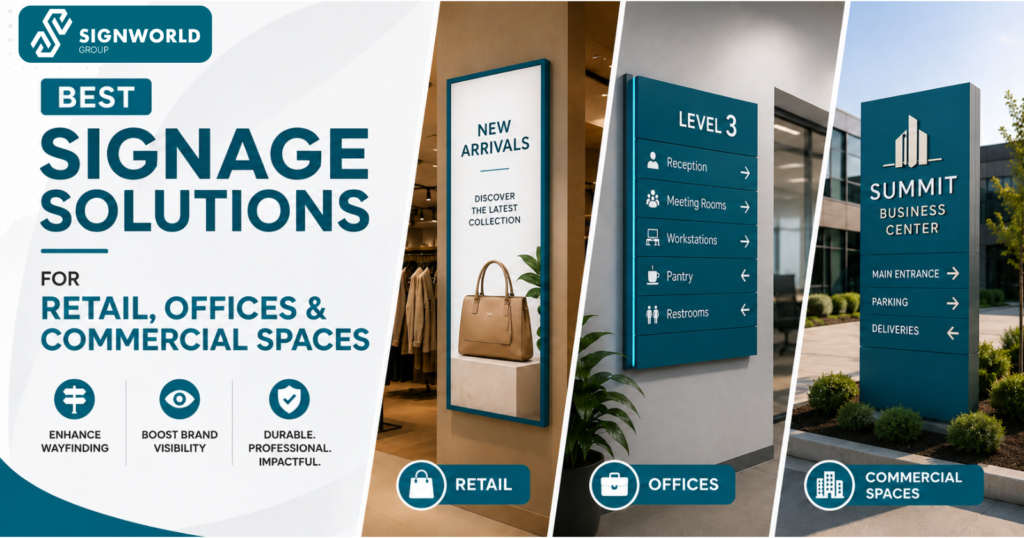
For UK businesses comparing retail signage UK, office signage UK or wider commercial signage solutions, the best choice depends on the building, the customer journey, the viewing distance and the purpose of each sign. A high street retailer may need a strong fascia sign, window graphics and in-store signs. A professional office may need reception signage, glass manifestations and internal direction signs. A commercial estate may need monolith signs, tenant directories, car park signs and safety signs.
SignWorld Group works with businesses that need signage to look professional and perform well in real commercial settings. This guide explains the main signage options for retail, office and commercial spaces, where each type works best, and what to consider before starting a signage project.
Retail signage that helps customers notice and enter
Retail signage has to work fast. People walking past a shop, driving through a retail park or browsing a busy high street will not study a sign for long. They need to understand the business name, the type of products or services offered, and whether the shop is relevant to them.
A fascia sign is usually the most important part of a retail shopfront. It sits above the entrance and gives the business its main street presence. A clear fascia sign can make a shop easier to spot from across the road, from a car park or from a busy pavement. The design should not try to say everything. In most cases, the business name, logo and a short service description are enough.
For example, a food shop, clothing store, pharmacy, estate agency or showroom will each need a different style of fascia sign. Some may suit flat panels with clean lettering. Others may need built-up letters, tray signs or illuminated signs to stand out in darker hours. The material and finish should match the brand, but they should also suit the building frontage and local setting.
Window graphics are another useful part of retail signage UK projects. They can show opening hours, service areas, seasonal offers, product categories or contact details. They can also give privacy where needed, especially for salons, clinics, estate agents and service-based shops. Frosted graphics can create a cleaner look, while full-colour vinyl can support campaigns and promotions.
The main mistake with window graphics is trying to use every inch of the glass. Too much text can make a shopfront look cluttered and difficult to read. A better approach is to keep the message simple. The window should tell people what the business does, what is available inside, and what action they can take next.
Illuminated signs are useful for retailers that trade in the evening or sit in locations with lower visibility. Restaurants, convenience stores, gyms, pharmacies, takeaways, showrooms and retail park units often benefit from lighting. A sign that looks clear in the daytime may disappear in winter evenings if it has no lighting. LED letters, halo-lit signs, lightboxes and illuminated sign trays can all help, depending on the site.
Inside the store, signage should help customers move without asking for help at every step. Department signs, product category signs, till signs, fitting room signs, collection point signs and return desk signs can make the shop easier to use. This matters because confusion can reduce sales. If customers cannot find what they need, they may leave before buying.
For retail businesses, signage should support the full journey from outside to inside. The fascia sign gets attention. The window graphics explain the offer. The internal signs help people move. Promotional signs point customers towards key products or services. When these signs work together, the shop feels clearer and more professional.
SignWorld Group can help retailers choose signage that suits their shopfront, brand style and customer flow. This is especially useful when a business is opening a new store, refreshing an old frontage, or trying to improve visibility in a competitive area.
Office signage that makes the workplace feel organised
Office signage has a quieter job than retail signage, but it is just as important. A visitor arriving for a meeting should know they are in the right place. Staff should be able to move through the building easily. Meeting rooms, departments, toilets, exits and shared spaces should be clear without making the interior look crowded.
Reception signage is often the first thing to consider in an office. A bare reception wall can make even a good business look unfinished. A well-made reception sign gives the entrance a clear focal point and supports the brand from the moment someone arrives. It may use acrylic letters, built-up metal letters, printed panels, illuminated logos or a mix of materials.
The style should match the type of business. A legal office, finance firm, clinic, estate agency, design studio or technology company will not all need the same look. Some offices need a formal and clean finish. Others may want a more modern or creative appearance. The aim is not to make the sign too loud. It should feel right for the space and the people who visit it.
Wall graphics are also useful in offices. They can add brand values, service messages, maps, timelines, local imagery or simple design features to otherwise plain walls. In reception areas, they can help explain what the business does. In meeting rooms, they can support a more professional setting. In staff spaces, they can make the workplace feel less empty without heavy building work.
Glass manifestations are common in modern offices because many workplaces use glass doors, meeting rooms and partitions. These graphics make the glass easier to see and can improve privacy. A simple frosted band may be enough in some spaces. Other offices may choose branded patterns or partial privacy panels. The design should still allow light through where possible, especially in smaller offices.
Directional signs are another key part of office signage UK projects. Visitors should be able to find reception, meeting rooms, lifts, stairs, toilets and exits without confusion. Staff also benefit from clear room names, floor signs and department signs. This is especially useful in shared offices, serviced offices, business centres and multi-floor workplaces.
Where buildings have several rooms, floors or departments, Wayfinding signage should be planned carefully. The wording needs to be simple, arrows should be consistent, and signs should appear before people need to make a decision. A direction sign placed after the turning point is not helpful. The best systems guide people naturally through the space.
Good office signage can also reduce small daily interruptions. If visitors keep asking where to go, reception staff lose time. If new staff cannot find rooms or departments, the workplace feels harder to use. Clear signs solve these simple problems and make the office feel better managed.
Commercial signage solutions for larger sites and shared buildings
Commercial signage solutions cover a wide range of buildings and sites. This can include business parks, warehouses, industrial units, clinics, educational buildings, leisure sites, showrooms, multi-tenant offices and mixed-use developments. These spaces often need more than one type of sign because they have several entrances, routes, users and safety needs.
Monolith signs are useful for commercial sites where the building is set back from the road or where several businesses share one location. A monolith sign at the entrance can confirm the site name, show tenant names, or guide visitors towards parking and reception. It gives the site a stronger presence before visitors reach the building itself.
For business parks and commercial estates, tenant directory signs are also important. Visitors often arrive looking for one company among several. A clear directory at the entrance, reception area or lift lobby can save time and reduce confusion. It should be easy to update if tenants change, as outdated directories quickly become a problem.
Car park signs are another practical need. These signs guide drivers to visitor parking, staff parking, disabled bays, loading areas, entrances, exits and pedestrian routes. In larger commercial settings, car park confusion can cause delays and safety risks. Clear signs help drivers make decisions early, rather than stopping suddenly or turning in the wrong place.
Safety signs are essential for many commercial buildings. Fire exit signs, first aid signs, warning signs, no entry signs, loading bay signs, PPE signs and restricted area signs all support safer movement around a site. These signs should be easy to see, placed in the correct areas and made from materials suitable for the environment.
Warehouses and industrial units often need more practical signage than a standard office. Loading bays, goods-in areas, pedestrian walkways, vehicle routes and restricted zones must be clear. Signs in these areas need to be durable and readable from the right distance. A small sign may work in a corridor but fail in a yard or warehouse.
Commercial signage should also support the brand. A business unit with no clear external sign can look temporary or difficult to trust. Building signs, entrance signs and branded internal graphics help make the company feel established. This matters when clients, suppliers, contractors or new staff visit the site.
SignWorld Group can support commercial clients with signage that covers both presentation and practical use. This is important because commercial sites often need signs that guide people, improve safety and present the brand in a consistent way.
Indoor and outdoor signage: what changes?
Indoor and outdoor signage may look similar in design, but they have different requirements. Outdoor signs need to deal with weather, sunlight, dirt, wind and changes in temperature. Indoor signs usually focus more on finish, readability, brand style and how people move through a space.
Outdoor signage includes fascia signs, illuminated signs, monolith signs, car park signs, external direction signs, building signs and some window graphics. These signs must be made from materials that can last outside. They also need secure fitting, especially where wind, height or public access are involved.
Indoor signage includes reception signs, wall graphics, glass manifestations, room signs, floor directories, tenant directories, directional signs and safety signs. These signs are usually viewed from a shorter distance, so finish and detail matter more. A reception sign, for example, may be seen closely by clients and visitors, so rough edges or poor fitting will be noticeable.
The best signage plans consider both areas together. A person arriving at a business does not think in terms of outdoor and indoor signs. They simply move from the road to the car park, from the entrance to reception, and from reception to the right room or department. Each sign should make that journey easier.
This is why site planning is important. Businesses should not only ask, “What sign do we need?” They should also ask, “Where will people be when they need this information?” That question often leads to better placement, better wording and fewer wasted signs.
Choosing the right signage materials
Material choice affects the look, cost and life of a sign. Some materials work well indoors but are not suitable for long-term outdoor use. Others are strong enough for external signs but may be too heavy or unnecessary for simple interior graphics.
Acrylic is often used for reception signs, office branding, wall-mounted logos and internal panels. It gives a clean finish and can be cut into letters or shapes. It can also be paired with print or lighting for a more detailed look.
Aluminium composite is widely used for outdoor panels, fascia signs and general commercial signs. It is strong, light and suitable for many external settings. It can carry printed graphics, vinyl lettering or painted finishes.
Vinyl is used for window graphics, wall graphics, glass manifestations and short-term promotional signs. It is flexible and can work well on smooth surfaces. Different types of vinyl are available depending on whether the sign is temporary, long-term, indoor or outdoor.
Built-up letters add depth and can make a sign look more premium. They are often used for shopfronts, reception areas and building signs. They can be made from acrylic, metal or other suitable materials, depending on the required finish.
LED lighting is used for illuminated letters, lightboxes, halo-lit signs and sign trays. It helps signs remain visible in darker conditions and can make a business easier to find outside normal daylight hours.
Foamex and similar lightweight boards can work well for indoor displays, temporary signs and cost-conscious internal projects. They are not always the best choice for permanent outdoor use, so the location should guide the decision.
SignWorld Group can advise on material choices based on where the sign will sit, how long it needs to last, how it should look, and what budget range is realistic. For businesses planning costs before they start, a Cost guide can help give a clearer idea of what may affect the final price.
How signage supports enquiries and lead generation
Signage can help generate leads in a practical way. It increases visibility, makes the business easier to find, improves trust, and helps people take the next step. This is especially important for businesses that depend on local footfall, passing traffic, appointments or site visits.
For retail businesses, clear signage can increase walk-ins. A person may not search online for a shop if they do not know it exists, but they may enter after seeing a clear shopfront, window message or illuminated sign. The sign becomes part of the sales process before anyone speaks to the customer.
For offices, signage supports confidence. A client arriving at a clean reception with professional branding is more likely to feel they are dealing with an organised company. This matters in sectors such as finance, legal services, property, healthcare, recruitment and consultancy, where trust is important.
For commercial spaces, signage reduces friction. If visitors can find parking, reception, the right tenant or the right department without confusion, their first experience is better. That can affect how they feel about the business before the meeting, appointment, or purchase begins.
Signage also helps repeat recognition. Someone may pass a shop, office or commercial site many times before they need the service. Clear and consistent signage makes the name easier to remember. When the need appears later, that business is more likely to come to mind.
Businesses can also review Case studies to understand how signage works across different settings and how the right mix of signs can support visibility, movement and enquiries.
Common signage mistakes to avoid
One of the most common mistakes is making text too small. A sign that looks clear on a design proof may not be readable from across a road, through a car window or from the far side of a car park. Viewing distance should guide the size of the letters.
Another mistake is adding too much information. A fascia sign does not need to list every service. A window graphic does not need to explain the whole business. A direction sign should not use long wording. People read signs quickly, so the message should be short and clear.
Poor contrast can also weaken a sign. If the text colour is too close to the background, the sign may be hard to read. This can be a problem in bright sunlight, poor weather or low light. Contrast should be checked before production.
Some businesses also choose materials only by price. This can lead to outdoor signs that fade, bend or look worn too quickly. It can also lead to indoor signs that do not match the quality of the space. A cheaper sign is not always cheaper if it needs replacing sooner.
Inconsistent signage is another issue. If every sign uses a different font, colour, size or layout, the site can look untidy. Consistency helps people recognise the brand and follow directions more easily.
Leaving signage too late can also cause problems. Design, production, delivery and installation all take time. Larger projects may also need surveys, access planning, landlord approval or local checks. Businesses should plan signage early, especially when opening a new site or preparing for a launch date.
Planning a signage project with SignWorld Group
A signage project should start with the purpose of the signs, not only the design. The first question is what the business needs the signage to do. Does it need to attract more footfall, make a site easier to navigate, improve a reception area, guide drivers, support safety, or refresh the brand?
The next step is to review the site. This includes shopfronts, entrances, reception areas, corridors, windows, car parks, lifts, stairwells, meeting rooms and any areas where people may become unsure. A simple site review can reveal where signs are needed and where existing signs are not working.
After that, the design can be developed around the brand and the practical use of each sign. The design should look professional, but it should also be readable and suitable for its location. A sign that looks attractive but cannot be read from the right distance will not do its job.
Material selection should then be matched to the setting. Outdoor signs need weather-resistant materials and secure installation. Indoor signs need the right finish for the space. Illuminated signs need planning for power, brightness and placement.
Installation also needs proper thought. Some signs can be fitted quickly, while others may need access equipment, out-of-hours work or coordination with landlords, site managers or contractors. Planning these details early helps reduce delays.
SignWorld Group can help businesses move through these stages in a more organised way. This is useful for single signs, full office branding, retail shopfronts and larger commercial signage projects.
Best signage options by use case
For a high street shop, the main priorities are usually a fascia sign, window graphics, opening hours, promotional graphics and internal category signs. These help people notice the shop, understand the offer and move through the space.
For a retail park unit or showroom, the business may need larger external signs, illuminated signage, window graphics, car park signs and clear entrance signage. These sites often rely on customers arriving by car, so visibility from a distance is important.
For a professional office, reception signs, wall graphics, glass manifestations, room signs and directional signs are usually the most useful. These signs improve first impressions and make the workplace easier to use.
For a shared commercial building, tenant directory signs, lift lobby signs, floor signs, entrance signs and safety signs are important. They help visitors find the right business without relying on staff for directions.
For warehouses and industrial units, external building signs, loading bay signs, safety signs, vehicle direction signs, car park signs and restricted area signs are often needed. These signs help with safety, deliveries and daily site movement.
For clinics, training centres and service-based premises, reception signs, privacy graphics, directional signs, room signs and safety signs can improve the visitor journey. They also help people feel more confident when arriving for an appointment.
Why choose SignWorld Group
SignWorld Group provides signage for retail, office and commercial spaces where the sign needs to look right and work properly. The company can support businesses that need a single sign, a full signage package, or a refresh across several areas of a site.
Many businesses know they need signage but are not sure which type will suit their building, brand or budget. SignWorld Group can help with practical guidance, from choosing materials to planning where signs should be placed.
The company understands that signage has to do more than look presentable. A sign must be readable, suitable for its environment, fitted securely and designed around the way people use the space. This applies to shopfronts, reception areas, car parks, shared buildings and larger commercial sites.
For businesses comparing commercial signage solutions, working with a provider that understands both brand and practical use can make the project easier. It helps avoid signs that are too small, poorly placed, hard to read or unsuitable for the setting.
Conclusion
The best signage solution depends on the site and the people using it. A retail shop may need a fascia sign, window graphics and in-store signage to attract and guide customers. An office may need reception signage, wall graphics, glass manifestations and directional signs to create a more professional and organised space. A commercial site may need monolith signs, tenant directories, car park signs and safety signs to make movement safer and easier.
When signage is planned properly, it supports visibility, customer movement, staff guidance, safety, brand image and enquiries. It helps people notice the business, understand where to go, and feel more confident when they arrive.
For UK retail, office and commercial sectors, signage should be clear, durable and suitable for the building. The design matters, but so do the material, placement, installation and purpose of each sign.
Discuss your signage needs with SignWorld Group.