
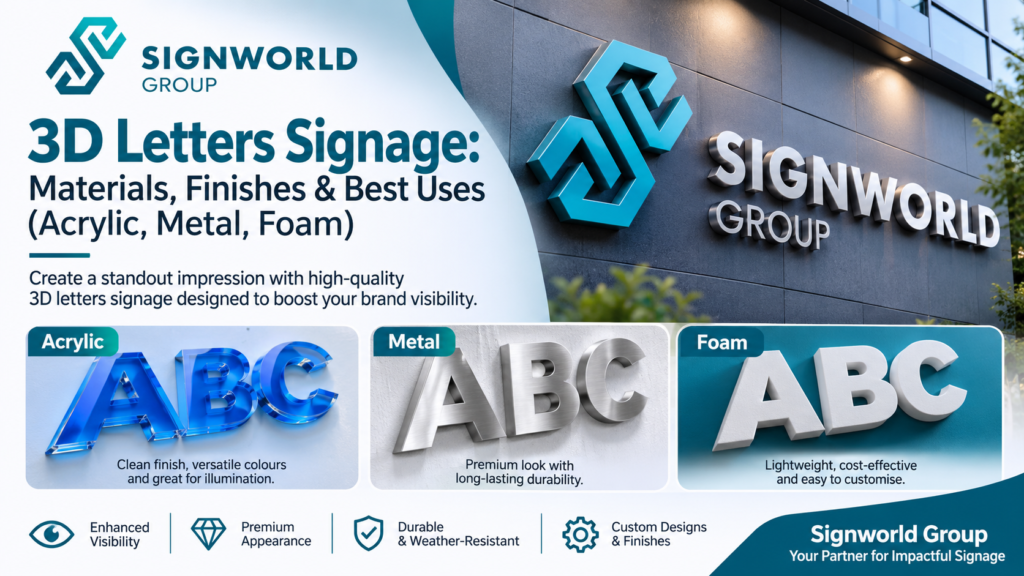
A 3D letters sign helps your company name, logo or message have some depth rather than having it flatly installed on a wall or fascia. With this added depth comes an enhanced viewing effect for your sign depending on where you look at it and can even help increase brand visibility along the street, reception area or commercial environment. It is equally important to consider the material that is used since there are a variety of choices available with each offering its own unique effects in terms of finish, weight and durability.
Signworld Group is a dimensional letters sign manufacturer for retail, hospitality, office, healthcare, leisure and other commercial environments all over the United Kingdom. Our dimensional letters signs are made using both flat cut and built-up techniques as well as offering options such as illumination and colour matching.
What Is 3D Letters Signage?
Three-dimensional lettering involves the use of letter forms or logos that have depth and hence the sign is projected out of the surface rather than being a two-dimensional printed graphic.
This can be done by either the thick flat-cut materials or the fabricated built-up letter that has a face, sides, and an open hollow space inside.
Depth can vary greatly; at Signworld Group we manufacture dimensional lettering ranging from about 5 mm flat cut signs all the way up to the built-up letters with depth of up to 100 mm depending on the design and application requirements.
Illumination will depend on whether the letters are illuminated, face-lit, halo-lit or push through acrylics. It will depend on viewing distance, opening times, wall color, brand image and budget among other considerations.
Businesses considering dimensional signage can view Signworld Group’s 3D Letters service for examples of available styles and applications.
Why Does Material Choice Matter for 3D Letter Signs UK?
In addition to appearance, the material has an effect on the weight, weather resistance, depth, method of mounting, budget and possible finishing. In 3D letter signs UK project the first thing you should pay attention to is not only the appearance of the sample. The sign should look good on the building and be able to withstand the everyday conditions. An outdoor sign mounted on the exposed facade will have other requirements than an indoor logo installed behind the reception desk. The outdoor letters will have to withstand the effects of rain, temperature fluctuations and winds, while an indoor sign may value the details and finish quality more. Among other materials used by Signworld Group in 3D letter production there are stainless steel, aluminum, acrylic, foam, timber and other sign materials. The company produces 3D signs at its own facility in the UK and performs design, production and installation work in-house. According to Signworld Group, the company has 30 years of experience in signage and UK based manufacturing and nationwide installation capabilities. This experience is especially important when talking about 3D letters, because the decisions made during design cannot be separated from fabrication process.
When Should You Choose Acrylic 3D Letters?
Acrylic is one of the most practical materials for 3D letters signage because it gives a clean, smooth finish and works well with modern brand colours.
It can be laser cut or routed into individual letters and logos, making it suitable for accurate shapes and detailed branding. Acrylic can also be produced in different thicknesses, allowing the lettering to create depth without becoming too heavy.
Reception areas are one of the most common uses. Acrylic letters mounted directly to a wall can give a clean branded finish without making the space feel too industrial. They work particularly well in offices, clinics, salons, estate agencies, professional services and modern retail interiors.
Acrylic also gives businesses plenty of colour choice. It can be supplied in standard colours, painted or combined with other materials. Clear, frosted and translucent finishes can also produce different effects.
For illuminated signage, acrylic often plays an important role because light can pass through selected grades. Signworld Group uses acrylic in options such as face-lit letters, push-through letters and illuminated built-up lettering.
One Signworld Group project for Honi Poke used aluminium returns with 5 mm opal acrylic for external built-up lettering. The same project also used stainless steel letters internally, showing how different materials can be selected for different parts of one signage scheme.
Acrylic is therefore a strong option when a business wants a neat finish, accurate colour and the option to add lighting without the weight associated with some metal constructions.
For more ideas on indoor use, Signworld Group’s guide to signage solutions for retail, offices and commercial spaces includes examples of reception lettering and branded interior signs.
When Are Metal 3D Letters the Better Choice?
Metal gives 3D lettering a more solid and architectural appearance. Stainless steel and aluminium are widely used for built-up letters, shop fascias, office entrances, hotels and corporate buildings.
Aluminium is relatively light for a metal sign material and works well for larger fabricated letters. It can also be powder coated or painted to match brand colours, which makes it useful where the business wants the strength of metal without a natural metallic finish.
Stainless steel is often selected when appearance is a major part of the specification. Brushed stainless steel creates a clean, professional look, while polished finishes produce more reflection and visual impact.
Signworld Group also works with brass, bronze, powder-coated aluminium and weathering steel across its wider metal signage range. Its metal fabrication capability includes laser cutting, CNC work and concealed fixing options.
Metal lettering works particularly well on high-quality retail developments, office headquarters, hotels and hospitality venues because it can form part of the architecture rather than looking like an added panel.
It is also a good choice for external signage where durability matters. The final specification still needs to consider the site, mounting surface and exposure, especially in coastal or highly exposed areas.
Businesses comparing metal options can also read Signworld Group’s guide to custom metal signs for more detail on outdoor metal signage.
Where Does Foam Lettering Work Best?
Foam lettering provides depth without the same weight or cost as many fabricated metal options. It can be cut into thick letters and logos, then painted or faced with another material to improve the appearance.
This makes foam useful for internal 3D signage, exhibitions, events, temporary displays, feature walls and some reception applications.
For example, a business may use thick foam letters with an acrylic face to create a deeper-looking sign while keeping the structure relatively light. This can work well on internal walls where full fabricated metal lettering would be unnecessary.
Foam also allows businesses to create larger lettering without placing the same load on the mounting surface. This can help where the sign is being fitted to an internal partition, display wall or temporary exhibition structure.
It is important to match the material to the setting. Foam would not usually be the first choice for a long-term exposed external fascia where metal or suitable acrylic construction can provide a stronger solution.
The finish also needs care. Foam can look very effective when properly cut, faced and painted, but rough edges or poor finishing become noticeable at close viewing distances. This is especially important in reception areas and customer-facing interiors.
What Finishes Are Available for Built-Up Letters?
The finish controls how the lettering works with the rest of the brand. Two signs made from the same material can look completely different once the surface treatment, colour and lighting are changed.
Painted finishes are useful when the sign needs to match a corporate colour. Signworld Group offers painted and vinyl-wrapped lettering with RAL, Pantone and custom colour options.
Powder coating is widely used with aluminium because it produces a consistent coloured finish and works well for commercial external lettering.
Brushed stainless steel creates a softer metallic appearance with a visible directional grain. It suits offices, hotels, financial businesses, professional services and premium retail settings.
Mirror-polished steel gives a brighter, more reflective result. It can work well in flagship interiors or high-end hospitality spaces, although the surrounding lighting and reflections need to be considered during design.
Halo illumination is another finish option rather than simply a lighting choice. LEDs behind the letter cast light onto the wall, leaving the face of the letter solid while producing a glow around the edges.
Face-lit letters work differently. Light passes through the front face, making the letter itself bright. This tends to create stronger visibility for retail, hospitality and businesses trading after dark.
The mounting method can also become part of the visual effect. Letters can sit directly against the surface or use stand-off fixings to create a shadow line.
Which 3D Letter Signs Work Best for Different Businesses?
Retail businesses normally need visibility first. Larger built-up letters made of acrylic or metal can add more depth to the shopfront than flat vinyl letters or a printed fascia. Lighting could also be good for businesses that operate in the evenings. Hotels and restaurants can gain from metal lettering as it provides more permanency for their entries and facades. Halo lit letters can be useful when the business needs light without making the face too bright. Corporate offices usually require more professionalism. Brushed metal letters or acrylic letters can be a good choice for the main entry while small acrylic or metal logos can be installed on reception walls. Healthcare and professional sectors may require clean and readable lettering. Acrylic lettering can be a good choice for these businesses since it allows for precise shapes and smooth finish. Warehouses and industrial buildings usually require size, durability and identification. Larger aluminum built-up lettering may be a good choice for such buildings because it creates depth without being too heavy. The reception signage should also be considered in its totality. Since the visitors usually see the reception logo up close, the spacing, finish and installation become extremely important.
How Can 3D Letters Signage Improve a Business Site?
A good signage system will not only help locate the business but contribute to creating a sense of completeness of the space. In a retail outlet, dimensional lettering will create greater visibility from the sidewalk or parking lot. Shadows created by the depth of lettering work to enhance the visibility during the day, while lighting is a possibility that will work to enhance the visibility at night. In a reception area, the function of the sign will be entirely different. It will provide visitors with an obvious reference point on entry into the space, and good finishing of the logo will help create more appeal to a dull wall without too much decorative effort being required. For multi-site businesses, the consistency can also be achieved by the use of 3D letter signs UK. Letter sizing, letter depth, colors and finishes can be made to follow the same specification even when the buildings used in each location may be different.
Why Choose Signworld Group for 3D Letter Signs?
Signworld Group has been active in the signage sector in the UK for over 30 years and manufactures signs in its UK factory. These include design, production, installation, and support services, with installations throughout the country available. This firm makes dimensional letters out of acrylic, stainless steel, aluminum, foam, and other materials and offers flat-cut, built-up, halo-lit, and face-lit versions. Designing and manufacturing together will also help make practical decisions. While a design may look fantastic on screen, it still requires correct letter depth, fixing points, spacing, and material thickness to become functional on a building. Signworld Group can check the wall or fascia, viewing distance, brand artwork, and lighting needs before suggesting a structure.
Conclusion
No one material will serve all projects equally.
For contemporary environments and reception walls, acrylic is a good choice. For deep and large lettering, aluminium will be appropriate where weight is an issue. Stainless steel provides a great architectural look for office signs, hotel signs and luxury retail environments, but foam will be more economic when depth is required inside.
Your material will depend on the environment, size, distance, finish and longevity of the signage project.
If you need to install new 3D letters signage, we can assist you with the choice of materials and other aspects of your signage project. Please visit the 3D Letters page or Signworld Group for further details.
Frequently Asked Questions
What material is best for 3D letters signage?
This will depend on the location of the sign. Acrylic is best for reception area and contemporary retail signage while aluminium and stainless steel work well for many outside and architectural applications. Foam is better suited to light-duty indoor signage applications.
What are built-up letters?
Build-up letters refer to three-dimensional letters which have a face and side returns that give them added depth compared to ordinary flat cut letters. They may have metal or acrylic material or both with an added lighting effect internally using LED lights.
Can 3D letter signs UK projects be illuminated?
Some of these include halo lighting, where the LED lights illuminate the wall behind the letter, and face lighting, where the light passes through the face of the letter. The correct one will be decided based on the design, location, and intended visibility of the sign at night.
Are acrylic 3D letters suitable for outdoor use?
Yes, provided that the construction, material thickness, fixing, and installation methods suit the specific application. For outdoor signs on a large scale, aluminium or metal construction could be better suited.