
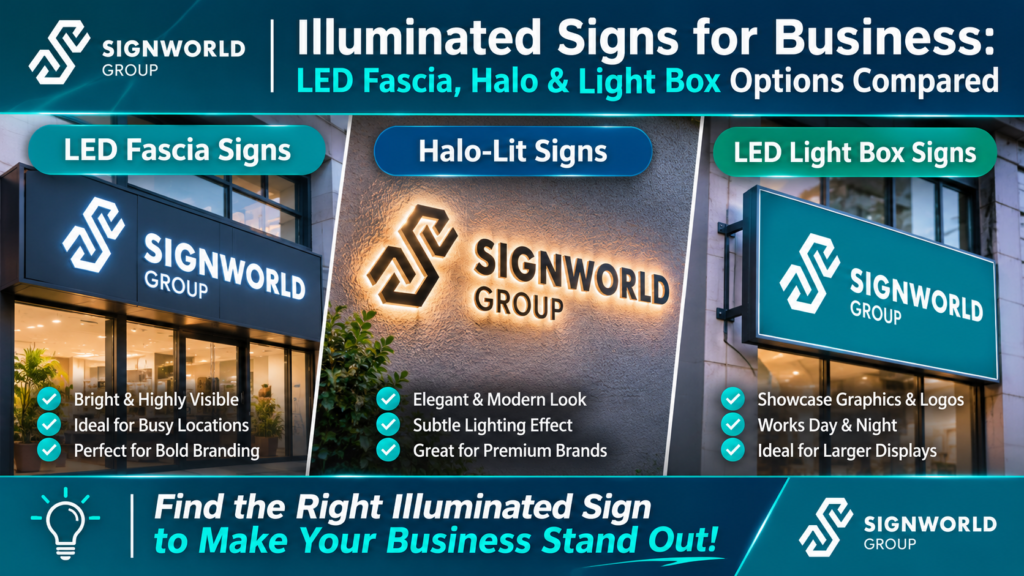
Whereas one retail outlet would like to see its sign illuminated in such a way that it can be read even when the customers are at a distance in a crowded parking area, another may like soft lighting that works with the building itself. Both require good signage, though the ideal signage would be totally different for both.
Among those illuminated signs suppliers in the UK provide businesses to choose from, there are three types that stand out because of their distinctive appearance and operational processes. They are the face-lit LED fascia sign, the halo-lit sign and the illuminated light box. Knowing about their working and suitability can make you pick signs suitable for your business place rather than going for the brightest one.
Illuminated Signs UK: Understanding the Main Options
Illuminated commercial signage is basically divided into three types, although sometimes it is a combination of different types of lights that are used for signage. The major distinguishing feature between these types of signs is the way light goes through or around the sign.
LED face-lit signs use light passing through letter faces, making them very clear and bright. LED halo-lit signs use light pointed at the mounting surface behind three-dimensional letters. Lighted LED panels or boxes contain an illuminated area which can be used for lettering and graphics.
LED Face-Lit Fascia Signs: Maximum Legibility Where It Matters
The use of face-lit LED lettering is especially helpful for companies which require the company’s name to be identifiable amidst all other competing nearby businesses. The letters normally have a three-dimensional channel design, which contains LED modules and uses a translucent face made of acrylic material that allows light transmission.
This way, lighting is directly focused only on the letters themselves without the need to illuminate the whole fascia. Thus, this type of sign is ideal for use in very busy retail environments, including shopping parks, gyms, pharmacies, and restaurants.
Visibility and Brand Presentation
Take an example of a pharmacy located between several brightly lit shops. It is important for its sign to be legible during the dim winter afternoons especially to those coming from the other side of the road or even through the parking lot. Properly proportioned letters lit from the face will help accomplish this without lighting up the whole shop front.
However, it should be noted that just being bright is not enough for a sign to be legible. The size of the letters, their spacing, typography and even the level of contrast will still be important especially for signs that are viewed at greater distances.
Installation and Maintenance Considerations
Face-lit letters need to have sturdy mounting and proper electrical connections along with an even illumination system. Unfortunate placement of LEDs may result in bright spots appearing in the letters, and lack of thoughtfulness regarding easy component access may lead to difficulty in repair.
The issue of cleaning is also important, especially in cases when signs are posted at busy streets, where the accumulation of pollution and dust becomes inevitable. LED drivers and modules need to be easily accessible for any necessary maintenance or replacement as well. Over-brightness leads to glare, therefore, the sign needs to function according to its environment.
Halo-Lit Signs: A More Subtle Architectural Effect
Halo-lit lettering uses a different approach. Instead of illuminating the front of each letter, LEDs direct light backwards towards the wall or mounting panel.
Why the Mounting Surface Matters
The success of halo lighting depends heavily on the surface receiving the light. A smooth, light-coloured wall generally reflects illumination more effectively than a dark or heavily textured surface. Brickwork, uneven render and other architectural finishes can create differences in the halo’s appearance, even where the lighting inside the letters is consistent.
The distance between the letters and the wall also affects the light distribution. Appropriate mounting spacers allow the illumination to spread behind the lettering, while unsuitable spacing may create an uneven or restricted glow. Letter dimensions, LED positioning and surface colour should therefore be considered together during design.
Halo lit signs are not automatically more suitable for every business. On a brightly illuminated high street, reflected light may be less noticeable from a distance than direct face-lit lettering. Electrical connections and mounting arrangements can also require careful planning, particularly where the building’s appearance must remain undisturbed.
LED Light Box Signs: Illuminating Larger Graphic Areas
LED light boxes illuminate a complete panel rather than individual letters. A typical installation consists of an aluminium enclosure, internal LED lighting and a translucent face containing printed graphics, lettering or logos. Depending on the design, illumination may come from LEDs positioned behind the panel or an edge-lit arrangement that distributes light through the sign face.
This construction is useful when branding involves more than a business name. A takeaway displaying a detailed logo, for example, may find a light box easier to specify than manufacturing several separately illuminated graphic elements. Light boxes are also used for shopfront signage, shopping-centre directories and other commercial displays where a consistent illuminated graphic area is required.
Single-Sided and Double-Sided Light Boxes
Single-sided light boxes are generally mounted against building fascias or internal walls, while double-sided versions can project from shopfronts so pedestrians approaching from either direction can see the branding. Projecting installations require suitable structural support, safe clearance and consideration of exposure to wind and weather.
Traditional light boxes commonly use rigid acrylic or similar translucent panels. Larger commercial installations may instead use flexible printed material tensioned within a frame. These flex face signage systems can accommodate extensive illuminated graphics across long retail fascias.
Face-Lit vs Halo-Lit vs Light Box Signs: Which Is Better?
The three options serve different commercial and architectural requirements. Comparing them by illumination method, design flexibility, installation complexity and maintenance needs provides a more useful basis for selection than judging appearance alone.
Face-Lit LED Signs
Face-lit signage directs light through translucent lettering, making the business name clearly visible against the fascia. This approach works particularly well in busy retail environments where direct illumination and straightforward recognition are priorities. Individual letters can be manufactured in different sizes, shapes and colours, although complex lettering and numerous illuminated elements may increase fabrication and installation requirements.
Halo-Lit Signs
Halo illumination reflects light onto the surface behind the lettering, creating a softer appearance that can complement the building’s architecture. It is commonly suited to hospitality premises, professional offices and commercial entrances where a restrained lighting effect is preferred.
The finish and colour of the mounting surface influence the result, making installation details particularly important. Material selection, mounting distance, electrical access and the complexity of the lettering all affect cost. Halo lighting may be less noticeable than face-lit alternatives in particularly bright surroundings.
LED Light Box Signs
Light boxes distribute illumination across a larger graphic area, making them practical for detailed logos, printed artwork and substantial fascia displays. Their construction can accommodate single-sided or double-sided arrangements, and larger systems may use tensioned flexible faces instead of rigid panels.
Installation requirements depend on cabinet dimensions, fixing positions, electrical access and whether the sign projects from the building. Ongoing maintenance can involve cleaning the face, replacing graphics and accessing internal lighting components.
How Much Do LED Illuminated Signs Cost to Run?
Electricity consumption depends on the complete lighting system, operating hours and the price paid for electricity. A large illuminated fascia operating throughout the night will have different running costs from a smaller installation used for only a few evening hours, even where both use LED technology.
Illustrative Running-Cost Example
Assuming that there is an illuminated sign having an input power of 150 watts with a running time of 10 hours every day using an illustrative electricity rate of £0.25 per kilowatt hour, the power will be 0.15 kW and its yearly operation will be 3,650 hours.
The above calculation is done using the total input power in electricity of the whole system. Using timers, photocells, and proper dimming control could limit the number of unnecessary running hours.
Maintenance and Lifespan: What Should Businesses Expect?
Illuminated sign panels come with various components which have different maintenance requirements. These components may not last for the same depending on whether they are located indoors or outdoors. Outdoor sign panels are often exposed to rain, weather changes and pollution, and therefore, the components may not last for the same time. Face-lit signs will have to be maintained by cleaning the acrylic faces and accessing individual letters to carry out necessary maintenance. Halo-lit sign panels should have proper ways of accessing their hidden lights and connections.
Which Illuminated Sign Is Right for Your Business?
Face lit lettering is usually used to light up the sign for high street shops. The most important criteria here would be the lettering proportions and colour contrast.
Restaurants and cafes could opt for halo lit lettering because the lighting here should complement the character of the building. In case the establishment is located near some busy road, it might be better to use the face lit signage.
Retail parks would need bigger lettering and larger areas of illumination. Face lit letters and light boxes can both be used here depending on the size and complexity of branding.
Shopping centre signposts should take into consideration the landlord’s signpost rules concerning materials, size, brightness and installation. The choice can be made between the individual illuminated letters and light boxes.
The Commercial Value of Choosing the Right Illuminated Sign
The value of illuminated signs is in assisting clients to recognize buildings when they are open. In cases where business operations extend up to the night time, there is a need for illuminated signs that will assist people during winter when darkness comes way earlier than closing time.
Having a consistent font and colors can help create a recognizable brand through multiple buildings. In facilities and property management, it is important to use replaceable parts and have an easy access for maintenance.
What is needed here is an effective sign that performs well in the building, is easily legible and easy to maintain.
Why Choose SignWorld Group for Illuminated Signage?
Signworld Group is a UK-based company that produces signage for commercial use and has more than 30 years’ experience in the signage industry. The firm explains its in-house manufacturing facilities in the UK and provides services that include designing, fabrication, installation and maintenance of signs.
The capabilities provided by Signworld Group are pertinent to illuminated signage in that the final look will be determined prior to the start of manufacturing. Letter design, materials, LED placement, fixation and electrical access all affect the installation process.
Signworld Group provides illuminated signage services that include face lit channel letters, halo lit letters and light boxes.