
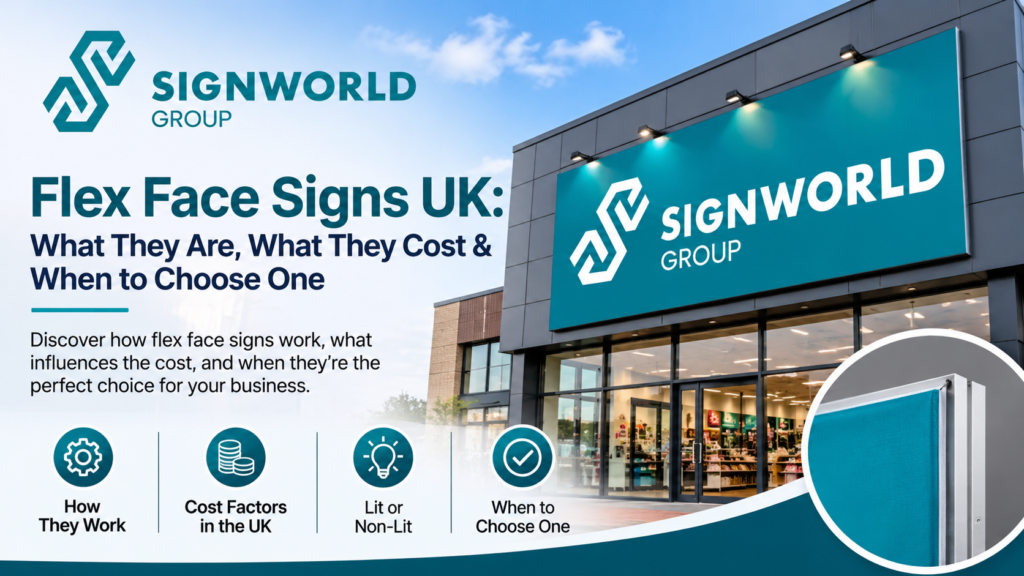
A supermarket having a 20-meter frontage requires signage that appears uniform throughout the premises. The manager of a retail park may require replacing signage without taking down the complete structure. These are situations where flex face signage deserves consideration.
Among the flex face signs UK businesses can specify, tensioned systems offer a practical way to display large-format graphics using flexible printed material secured within an aluminium frame. They can be either lit up or non-lit signs, depending on the construction.
Just the size of the sign doesn’t make it appropriate. All aspects should be considered before making any quotation. These include construction, ease of installation, weather, and even future alterations to graphics.
What Are Flex Face Signs and How Do They Work?
A flex face sign is a sign with a flexible printed face mounted on an aluminum backing frame. The printing is stretched by means of a mechanical system. The stretching of the fabric is important since without it, large faces would be likely to wrinkle and sag.
In contrast to a standard light box that uses acrylic material for its rigid faces, the flex face system uses the stretched fabric to make the face of the sign.
How Are Flex Face Signs Made?
Manufacturing a flex face sign involves several connected decisions. Frame construction, substrate selection and lighting arrangements all influence the finished result.
Aluminium Frames and Structural Support
The majority of flex face sign systems utilize aluminum extrusion specifically designed for this application. The frame should be able to keep the membrane taut and withstand the effects of different kinds of external forces like wind force.
External frames should also have suitable details regarding drainage, protection against corrosion, and maintenance.
Printed Flex Face Materials
The flexible PVC substrates are normally used for tensioned signage but specifications will differ depending on different manufacturers.
In case of illuminated displays, the material should transmit light properly without affecting the original colors to be printed.
The artwork developed for standard printing may require some modifications to be used for backlit graphics.
Dark colors occupy much less light than the light colors do.
The final face is ready to accept the selected tensioning system. Proper installation ensures that the tension is applied along the edges and aids in maintaining a smooth surface.
LED Lighting and Installation
In case of internal illuminated signs, the installation of LED lights should be done in a manner that will provide even illumination on the face of the sign. The cabinet depth, LED light placement and face material will determine how evenly the light is spread. Wrong placement of the lights may cause darker or brighter spots.
The drivers, wirings, and connections should be easily accessible in case there is future maintenance work. Before installation, a site survey should be conducted to determine the size, accessibility, fixings, and suitability of the structure.
The installation team will then know the lifting and tensioning systems to use.
How Much Do Flex Face Signs Cost in the UK?
Flex face signage prices depend on the complete installation, not simply the amount of printed material required.
- A non-illuminated fascia mounted at an accessible height will have a different cost structure from an illuminated sign requiring extensive electrical work and specialist high-level access.
- Main Factors Affecting Price
- Sign dimensions: Larger installations require more material, longer framing sections and potentially additional structural support.
- Illumination: LED modules, drivers, wiring and suitable cabinet construction increase manufacturing and installation requirements.
- Printed material: Substrate quality, artwork specifications, print finishing and material compatibility affect production costs.
- Structural considerations: The means of fixing the sign, the framework, and engineering assessments can affect the total cost.
- Accessibility for installing the sign: Height of installation, special lifting equipment and constraints on the site can have a large impact on labour and equipment costs.
- Removal of existing signage: Removal and disposal of an old sign could lead to increased costs, especially where repairs are needed to the underlying wall.
- Height of installation can have a significant impact on the cost of a sign.
- A sign located above a busy entrance of a retail shop might need a mobile working platform, pedestrian management or installation outside of trading hours.
- Getting a Meaningful Quotation
- Provide the approximate width and height, photographs of the building, installation address and intended artwork.
- Specify whether the sign should be illuminated and whether existing signage needs removing.
- For illuminated installations, confirm whether a suitable electrical supply is already available.
Installation height can have a substantial effect on cost.
A sign fitted above a busy retail entrance may require a mobile elevating work platform, temporary pedestrian management or installation outside normal trading hours.
These costs do not necessarily increase in proportion to the sign’s area.
Getting a Meaningful Quotation
Provide the approximate width and height, photographs of the building, installation address and intended artwork.
Specify whether the sign should be illuminated and whether existing signage needs removing.
For illuminated installations, confirm whether a suitable electrical supply is already available.
SignWorld Group’s published commercial signage cost guide discusses broader UK signage pricing, but general price ranges should not be treated as quotations for a specific flex face installation.
The Cost of Future Replacement
A major consideration is whether the existing frame can be retained during rebranding. Replacing the printed membrane may involve less fabrication work than replacing the entire sign. The savings depend on the frame’s condition, compatibility with the new face and the access required for replacement.
LED Flex Face Signs Are They Worth Choosing?
Internal illumination is useful where a sign must remain recognisable after dark.
A supermarket operating late into the evening may benefit from an illuminated fascia. A warehouse used primarily during daylight hours might not need the additional electrical installation.
LED flex face signs generally contain lighting modules positioned behind the translucent printed face.
The layout must account for cabinet depth, face colour and the required light distribution.
Brightness and Operating Costs
Even illumination is usually more useful than excessive brightness.
A sign with large areas of uneven light can appear poorly finished, regardless of how powerful its LEDs are.
Surrounding buildings, nearby residential windows and road users should also be considered.
Running costs depend on total electrical consumption and operating hours.
Annual electricity cost = Power consumption (kW) × Annual operating hours × Electricity tariff (£/kWh)
Use the complete system wattage, including power supplies, when comparing specifications.
Timers or suitable lighting controls can reduce unnecessary operation.
Businesses comparing different lighting methods can also review SignWorld Group’s illuminated signage options.
Where Do Flex Face Signs Work Best?
Retail Parks and Large Shopfronts
Retail park buildings often have long fascia areas designed to accommodate prominent tenant branding.
A tensioned face can provide a continuous printed graphic across a substantial width.
Lettering size and contrast should still reflect the distance from which customers approach.
Petrol Stations and Forecourts
Forecourt signage is exposed to weather and often needs to remain visible outside daylight hours.
Flex face illuminated signs may suit certain fascia and canopy applications, provided the structure and electrical arrangement are suitable.
Wind loading, mounting details and maintenance access deserve particular attention.
Supermarkets and Multi-Site Retailers
Businesses with multiple premises can benefit from consistent artwork, materials and illumination specifications.
Standardised branding can make future replacement projects easier to plan, although individual sites may require different frames and fixings.
Industrial and Commercial Buildings
Large warehouses and distribution premises may need branding visible across extensive building elevations.
Flex face systems can accommodate substantial graphics, but building proportions and viewing distance should determine the final dimensions.
What Should Businesses Consider Before Ordering Flex Face Signage?
Begin with the structure rather than your preference for sign styles. Determine the dimensions of the fascia, distance from viewing and ambient light conditions. Take into account the wall construction, installation height and wind exposure.
The future possibility of sign changeovers needs to be taken into account, especially when dealing with leaseholders or businesses that will need frequent re-branding.
Permissions and Practical Requirements
Outdoor advertising in England is covered by advertisement-control legislation. Certain signage enjoys deemed consent, whereas other signs require explicit advertisement consent.
Illuminated signage usually warrants further consideration, and there may be additional requirements for listed buildings or sites. There may be further conditions for separate structural work, electrical work, and even landlord permission.
As rules vary in the UK, it is important to consult the appropriate local authority. Ensure that you have the guarantee and liability before approving the plan.
The Business Benefits of Choosing the Right Flex Face Sign
The key commercial benefit of flex face signage is its capability of carrying considerable amounts of branding through printing on large surfaces of buildings. Flex face can also serve as an alternative solution if the existing frame can be reused.
Consistent materials and graphic requirements may become helpful for keeping the same look between different locations in case of a chain.
Maintenance accessibility should be taken into account as well. The sign which can be checked and possibly fixed without any problems is likely to be easier to handle.
The biggest sign doesn’t always work best. Good visibility, proper scaling and lighting are much more important than using all the space.
Why Choose SignWorld Group for Flex Face Signage?
SignWorld Group describes more than 30 years of signage experience on its official website and identifies UK manufacturing as part of its production capabilities. Its services cover design, manufacture, installation and maintenance.
That combination is relevant to flex face projects, where the printed graphics represent only one part of the installation.
Frame construction, structural requirements, lighting design and site access must all be considered before production.
SignWorld Group’s flex face signage solutions cover large-format tensioned systems for commercial fascias and illuminated applications.
Discussing the proposed dimensions, building conditions and future maintenance requirements with the team can help establish a suitable specification.
Conclusion
Flexible face sign systems are an ideal solution for companies requiring large and highly visible signs in terms of their retail façades, fuel stations and commercial properties. Due to the versatility of the material, it is possible to use large prints and the possibility of substitution of sign faces makes further changes in branding easier.
The right choice of a material will vary depending on the size of your building, the viewing distance and even the way of installation. The aspects that should be considered also include quality, durability and ease of maintenance.
SignWorld Group will be glad to help you choose the right material.